Thursday, June 25, 2020

Pagan Portals--Ancestral Healing by Trevor Greenfield (ed.)

Moon Books
Published August 1, 2020
112 pages

Pagan Portals - Ancestral Healing by [Trevor Greenfield]This collection of essays by various authors focuses on various facets around healing with and through our ancestors. Irisanya Moon's piece, "Intergenerational Silence: Witnessing Yesterday to Heal Today," highlights the dangers around keeping silent after trauma and the ways in which we can heal through directly confronting the ancestors who kept us silent, as well as leaning on other ancestors to speak the trauma to.

Andrew Anderson in "Looking Them in the Eyes: Animals, Ancestry and Animism" links ancestral work to reconnecting in real ways to our animal brethren, specifically by becoming more aware of the role animals play in our modern food chain. Additionally, the fact that the animals we ingest ultimately become a part of our biological make-up, animals become, in their own way, ancestors to us humans.

Angela Paine addressed the importance of burying the dead to the grieving process in "Recovering the Bones, Healing the Past," while Mabh Savage explores "Dealing with Ancestral Shame." This one was my personal favorite, as I have been largely ambivalent to toward ancestral veneration in my own pagan practice primarily because I don't know that everyone in my line deserves such veneration. Savage makes the case for selective ancestor worship, which strikes me as a much less daunting approach.

While these essays have certainly given me a lot to consider on a personal level, I do find the collection to be a bit uneven. The great essays are really great, but there is an equal number here that struck me as rather meh, and some would have benefitted from a bit more editing. Still, the essays that struck me have stuck with me, so this is certainly a collection worth checking out if ancestral work is important to you.

Rating: 3/5

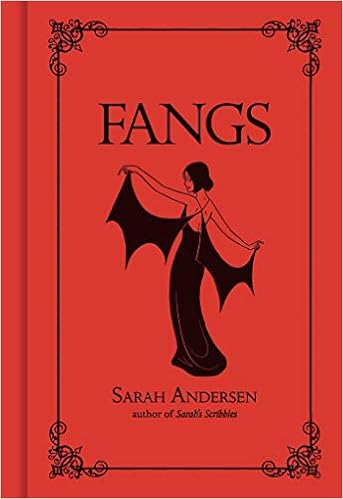
Fangs by Sarah Andersen


Andrews McMeel Publishing
Published September 1, 2020
112 pages

Sarah Andersen is the genius behind the "Sarah's Scribbles" comic strip and books, and her latest release is a delightful departure into paranormal adult romance that explores the more realistic possibilities around a vampire and werewolf falling in love.

The individual comics in the book tell a definite story, but they function more as snippets in time throughout the course of the relationship rather than a single fluid narrative. Many of the comics are humorous, most are outright adorable, and all end up as commentary on the joys of finding a partner who accepts all of you for who you are even when you are literally different creatures with your own histories and baggage.

In the end, there is much to enjoy here, even if you feel vampires and werewolves have been played out since 2012. These are not characters that are bogged down by centuries of literary monster lore, but instead feel fresh and relatable as two modern young people in love.

Rating: 3.5/5

Saturday, October 20, 2012

Shelf Life: Fantastic Stories Celebrating Bookstores edited by Greg Ketter

Prime Books
Published October 3, 2012
288 pages
Buy here.

If you are a bibliophile who can't get enough of bookstores, this is the book for you.  It's a collection of short stories by various authors that use bookstores as their primary setting (and sometimes as secondary characters!).  As the title indicates, all the stories are on varying points of the fantastic scale, and every story utilizes a bit of magic to tell its respective tale.  Since the target audience for this collection seems to be those who see even an ordinary bookstore as a place of magic, this only seems appropriate.  While the stories are all connected by their use of fantastic elements, the stories also employ quite a bit of contemporary realism (though there is at least one futuristic story, as well as a couple that are given historical contexts).  Yes, the bookstores are magical, but this magical quality is enhanced by their placement in modern society.  The stories are not set in an entire world of make-believe, and the bookstores in the stories serve for the characters a reprieve from, cause for, or solution to their problems.

A few stories stuck out to me on a first read as particularly enjoyable.  "A Book, by Its Cover" by P.D. Cacek, sees a bookstore owner in Nazi German using his shop as a means for others to escape, though not in any way that may be expected.  "The Hemingway Kittens" by A. R. Morlan explores the possibilities of scientific advancement in the form of two bookstore cats.  "Pixel Pixies" by Charles de Lint is a tale about a bookstore owner who is troubled by pixies that escape from her computer and a hob who tries to help her.  "Escapes" by Nina Kiriki Hoffman is a rather disturbing story about a woman who begins working in a bookstore after she moves to escape her sadistic ex-boyfriend, while "'I Am Looking for a Book...'" by Patrick Weekes is a hilarious jab at large-chain bookstores, relaying the frustrating experiences of Gorhok, a demon trying to find a book he needs to bring on the end of days that very night.

While the stories above are my particular favorites at this time, I definitely enjoyed all of the stories to varying degrees; I can't say there are any in this collection that I dislike.  If you are as enchanted as I by just the everyday regular bookstore, you will certainly find something to love in this collection.

Rating: 4/5

Friday, September 28, 2012

The Casual Vacancy by J.K. Rowling

Little, Brown
Published September 27, 2012
512 pages
Buy here.

Four words: This. Book. Is. Awesome.  It's dark, it's a bit gritty, it is everything I wasn't necessarily expecting from J.K. Rowling, and that is mostly why I enjoy it so much.

The official synopsis about the book that was released a few months ago focuses on the main plot thread: a man on a small-town council dies, and the rest of the book deals with what happens when heads bash in the election to re-fill his seat.  A fine synopsis, to be sure, but since this book is only 20% about this plotline and 80% about the characters, such a synopsis fails to do the book any real justice.

This is because in terms of a cohesive plot, that really is the gist of this 500-page novel.  Barry Fairbrother, who holds a seat on the Pagford town council, is in the midst of dying when the story begins.  What happens throughout the rest of the book revolves around a number of other families in town as the stage is set to choose Barry's replacement, but it is the details about and interactions between these families that really make this book what it is.  Relationships between husbands and wives, parents and their (adult and teenaged) children, students and their teachers, and council members and fellow council members take center-stage in this sprawling tapestry of a tale.

It's a point-of-view novel, so the character focus is constantly shifting as the full extent of characters' relationships to one another are slowly revealed throughout the book.  In this, Rowling succeeds in creating both incredibly fleshed-out characters and a level of mystery, and both of these created more than enough enticement for me to continue reading.  The characters themselves are largely unlikable and petty people, but in realistic ways that allow the reader to sympathize with (almost) all of them despite the dislike.  Pretty much everyone in this story is fairly miserable to some degree, but that misery is very human and lends to a degree of universality.  This in particular is what makes the book such a successful venture.

Rowling's writing in her new book is superb, her descriptions are vivid (I was particularly moved by Kay's first visit to the Weedons' home), and the dialogue flows wonderfully.  Given the tone, themes, and topics brought up in the story, it is absolutely, positively geared toward adults, and I would recommend leaving any and all Potter-based expectations at the door when reading this book.

Rating: 4/5

Monday, September 24, 2012

Courtney Crumrin and the Night Things by Ted Naifeh

Oni Press
Published April 11, 2012
144 pages
Buy here.

Originally published in 2003, this special hardcover reprint of the first volume of the Courtney Crumrin series is just eerie and bizarre enough to make me want to read more.  Teenaged Courtney is dragged by her parents to live with great-uncle Aloysius, who creeps her out at first but then earns her trust by revealing his magical secrets to her (and getting her out of a few jams when she takes it upon herself to uncover some secrets on her own).  The nearby forest is full of goblins, faeries, and other strange manner of creatures, which Courtney gets mixed up in very much against her will.  She also has to deal with bullies, being an outcast in a new school, and dangers in babysitting.  Full of magic and teen angst, this introduction to Courtney Crumrin has whetted my appetite for the slew of additional titles bearing her name.

Rating: 3.5/5

Long time no read

My end-of-summer was a bit crazy with worrying over finances and preparing three classes for the fall semester.  Now that I'm back into the swing of things at work, I will able to devote more time to reading again, which means much more updates here on the blog!  Fall officially began over the weekend, and with October fast approaching, my literary adventures will aim for ghoulish delights for a while.  Stay tuned if you're on the hunt for good things to read for Halloween!  I just finished an appropriately witchy graphic novel, so I should have a new post up either tonight or tomorrow!

Thursday, August 16, 2012

Read-Aloud Poems: Edited by Glorya Hale

Black Dog & Leventhal
Published September 11, 2012
288 pages
Buy here.

This is a lovely collection of 120 poems by some of the classic big names, including Stevenson, Wordsworth, Dickinson, Blake, Carroll, Whitman, Lear, Rossetti, Browning, and Angelou, plus many others.  The poems are thematically arranged by topics such as nature, family, and humor, and include some nice illustrations.

I didn't read a single one of these poems silently, so I will attest to the delight in reading them aloud.  The themes and content of all the poems are adult- and child-friendly, so this book would be a great addition to any parent's read-aloud repertoire (or even serve as a good starting point).  As a teacher, I could definitely see myself using this collection in an ESL class so students could practice pronunciation, rhythm, and sound-spelling relationships.

Rating: 5/5

Tuesday, August 7, 2012

With Respect to the Japanese by John Condon and Tomoko Masumoto (2nd Edition)

Nicholas Brealey Publishing
Published 2010
160 pages
Buy here.

This is a brief, very basic guide to assist American and Canadian business-people better understand the work culture of corporate Japan.  Topics are presented in a general compare/contrast between Japan and America, and cover points such as group mentality vs. individualism, the importance of social hierarchies, everyday interactions with co-workers and bosses, and differences in giving feedback to employees between the two cultures.  Also included is a chapter on the calendar year that covers the more important events and holidays that go on each month.  Overall, the authors provide their own impressions and knowledge, but they also include "data" of sorts in the form of general interview responses from Americans, Canadians, and Japanese employees and employers who have worked with one another in Japan.  Parts of it read almost like a research study, which I felt gave the whole book a bit more weight.

As an ESL teacher who occasionally has Japanese students in my classes, I found this book extrememly relevant, as work culture is, of course, connected to the wider culture of the country.  The book is quite short, but it is an informative and useful guide that acts as a great jumping-off point for further research on all the topics introduced.  I certainly learned quite a few things from this book, and I have every intention of furthering my cultural knowledge of the country beyond a working context, using Condon and Masumoto as a road map of sorts.

Rating: 4/5

Wednesday, August 1, 2012

Andy Squared by Jennifer Lavoie

Bold Strokes Books
Published September 18, 2012
216 pages
Buy here.

A work of LGBT young adult fiction, Andy Squared tells the story of seventeen-year-old Andrew Morris as  he goes through significant changes in his life after the catalytic arrival of new classmate Ryder Coltrane.  Ryder, who is gay, opens up to Andrew and helps Andrew realize just what it is that he has failed to understand about himself: that he too is gay.  While Andrew adjusts to this revelation and begins a relationship with Ryder, he must also deal with the challenges of his family and friends adjusting to it as well, particularly his twin sister, Andrea.

I found this to be a delightful coming-of-age and coming-out story.  I love the characters (and occasionally love to hate them), and I like that many of them, not just Andrew, are so dynamic in fairly dramatic ways.   Andrea, for example, goes through her own transformation of understanding her relationship with her twin after he comes out, and, as the title of the book suggests, she is as main a character as Andrew himself.  I actually found the Andrew/Andrea relationship slightly more intriguing than the Andrew/Ryder one, despite Ryder being the initial cause of all the change.  I think this is because Ryder seems to act mostly as a guide for Andrew, and their relationship ironically allows for Andrew an easy transition that balances the resulting conflicts in the other aspects of Andrew's life.  Just as important to the story, but definitely not as painful as Andrew's relationship with Andrea.

Overall, I really enjoyed this book.  The writing is wonderful (especially in the more physical scenes...tasteful yet steamy!), the dialogue feels genuine, and the characters and their motivations are believable.  This is Lavoie's debut work, and I very much look forward to reading more by her in the future!

Rating: 4/5

Saturday, July 28, 2012

Scott Pilgrim Volume One: Precious Little Life by Bryan Lee O'Malley [Color]

Oni Press
Published August 14, 2012
192 pages
Buy here.

I must begin this review by saying that this release is my first ever exposure to the Scott Pilgrim universe.  I have never read the comics before now, and due to my lack of interest in seeing anything starring Michael Cera, I skipped the movie.  The comics are now being re-released with added color, so I took the opportunity to finally acquaint myself with this series, and I must say I'm glad I did.

Scott Pilgrim didn't strike me as a particularly likable character at first.  He is twenty-three, lives in Toronto, and at the start of the comic has just begun dating a high school girl named Knives Chau whom he met on the city bus.  He's in a band and lives with/off his gay roommate, Wallace (who apparently ends up "stealing" all of Scott's sister's boyfriends).  He seems to lack motivation to really do anything, and I'm not sure if he even has a job.  Also, he's a twenty-three-year-old dating a high schooler.

Things start getting interesting for Scott, however, when he begins dreaming about a girl on rollerblades.  As it turns out, this girl exists in reality, and her name is Ramona Flowers.  After meeting her at a party, Scott starts to date her in addition to Knives.  He also begins receiving mysterious messages from a Matthew Patel.  In the big climax of this volume, Scott's band plays a show and Matthew Patel shows up to battle Scott to the death.  This battle consists of what I think is supposed to be a choreographed musical number that pits Scott and his crew against Matthew and his evil bat-girl minions.  Ramona informs Scott that if he wants to continue dating her, he must defeat her seven ex-boyfriends.

The plot is pretty basic, if not a bit bizarre, but the volume serves as a good introduction to all the characters, the setting, and the conflict for the rest of the series.  The writing is funny and the color definitely pops, so even though I kind of want to punch Scott in the teeth for being a bit of an idiot, I certainly want to keep reading the fun character interactions, over-the-top action sequences, and (I can only hope) more dance numbers.

If you're new to the series, give it a go with this re-release.  If you've already read every issue, at least check out the great color.  Volume 2, Scott Pilgrim Vs. the World, is out in color on November 7, 2012.

Rating: 4/5

Thursday, July 19, 2012

Shakespeare on Toast by Ben Crystal [Reprint]

Icon Books
Published September 11, 2012
272 pages

A blessedly brief work on the Bard, this book is a guide of sorts to approaching Shakespeare's works, either for the first or hundredth time.  Crystal begins with some background on Shakespeare and his plays, including Elizabethan audience expectations versus modern deifying of the playwright.  This tendency to put Shakespeare up on a pedestal is part of what makes people unwilling, nervous, or incapable of understanding and enjoying his writing.  Crystal also describes the Globe Theatre and how a typical performance of a play would have looked and sounded.  Not being a Shakespeare expert by any means, this was all information that I found fascinating, and reading just this far helped me to realize that simply reading Shakespeare in a classroom for analytical purposes is, without doubt, the least interesting way to experience Shakespeare.

Throughout the rest of the book, Crystal's main thesis is that Shakespeare wrote everything he did in the ways that he did with very deliberate purpose, and by understanding these methods it is possible to better interpret and act out the plays in a way closer to what Shakespeare seems to have envisioned.  By paying attention to prose vs. verse, any deviations from iambic pentameter, use of thou and you, and characters with no speaking lines, Crystal argues that readers can make more meaning out of plot and characterization.  He illustrates his tips with short bits of his own analyses.

Overall, Crystal does a wonderful job of presenting strategies that can help make Shakespeare more approachable, more understandable, and more enjoyable to the "average" reader, and would be a wonderful supplement in English classes.

Rating: 5/5

Buddy: How a Rooster Made Me a Family Man by Brian McGrory

Crown Trade
Published November 6, 2012
304 pages
Buy here.

In this well-written, laugh-out-loud memoir, McGrory writes all about his life prior to and after the death of Harry, a dog with which he had a wonderful relationship.  Life for McGrory after Harry involves a new wife, two stepdaughters, and a houseful of various animals, including Buddy the rooster.  Unlike Harry, Buddy more or less despises McGrory and has no qualms about letting that fact be well known.  In the end, though, life with Buddy helps McGrory realize how to better adjust to life in the suburbs and how to truly be a member of the family.

I found this book impossible to put down.  Not only is the writing brilliant, but McGrory's story runs a wide gamut of emotions.  His account of his relationship with Harry is touching, and it makes his relationship with Buddy all the more hilariously dysfunctional.  The descriptions of Buddy's various but calculated outbursts of hatred toward McGrory are probably my favorite parts of the book, and McGrory's indignant jealousy toward a family pet is understandable yet entertaining.

I cried, I laughed, I marveled, I wanted to read it again immediately.

Rating: 4/5

Tuesday, July 17, 2012

The Lucky Ones: My Passionate Fight for Farm Animals by Jenny Brown

Gotham Books
Published August 2, 2012
304 pages
Buy here.

Given that I love books about human-animal relationships, I was really expecting to enjoy this one.  What I got from this book, though, was a little more than I had bargained for.  Brown documents her journey from clueless meat-eater to extremely impassioned vegan on a mission to save whatever animals she can through her sanctuary in Woodstock, NY.  She also highlights the journeys of many of the animals themselves, describing their personalities and showing their individuality and worth as fellow living creatures.  Also included are basic facts and descriptions of the horrors of factory farming.

All of this is for the good, certainly, and I did really enjoy reading about the individual animals that Brown's organization had saved.  Everything else, though, came across as a little...overwhelming.  After a couple chapters, I had a really hard time stomaching the pathos oozing from every single page, the celebrity name-dropping, and the feeling that Brown sees anyone who continues to eat or raise meat as ignorant and/or heartless.  She is extremely opinionated and forthright in her views on animal cruelty, and while I certainly don't fault her as a person for that, it was just a bit more than I could deal with in her book.

Despite emotional appeal not being my personal cup of tea, I can see how this could be a great introduction to the topic for someone who is currently clueless about how factory farming operates.  She does do a good job of laying it all out, but again, for me, the raw emotion in the book is just too much.

Rating: 3/5

The Plant-Powered Diet by Sharon Palmer

The Experiment
Published July 17, 2012
400 pages
Buy here.

Recently I have been thinking more about my diet and realizing that I am still eating far too many carbs and fats, and not enough green stuff.  I was quite drawn to this book when I read the title, and I am pretty psyched to have stumbled upon it through NetGalley.

Palmer approaches plant-powered eating not necessarily as a "diet" as we typically understand it, but rather as a whole lifestyle change for overall health rather than, say, a quick weight loss program through brief periods of plant-centered eating.  The book is a super handy reference for anyone looking to cut out any amount of meat and animal-based foods from their diet, and Palmer stresses that it is as useful for omnivores as it is for vegans and vegetarians.  She outlines the benefits of various grains, vegetables, fruits, non-animal proteins and fat sources, herbs and spices, chocolate, dairy substitutes, and coffee, tea, and wine.  Each chapter includes very thorough lists of foods in each of these categories with nutritional and/or flavor descriptions and/or ways to use them.

Also included in each chapter are one or two assignments to help readers begin integrating these foods into their diets; this is a particularly helpful tool for those who don't know (or, like me, have forgotten) just how easy it is to do and need some help making small changes to their eating habits.  Additionally, there are tips on eating out and exercising, a 14-day sample menu, and loads of recipes, all of which are meat free (but which could easily be modified for those who want to include it).

Overall, Palmer provides great guidance as she holds readers' hands through the nutritional benefits of meatless/reduced meat eating, and I will certainly be referring to it myself as I get back on track with vegetarian eating.  Her approach is all-inclusive, and while she highlights the benefits of not eating meat, she does not take a holier-than-thou stance despite being a vegetarian herself.  I found the book well-written, easy to follow, and, above all, something I can really use to improve my own eating habits.

Rating: 4/5

Thursday, July 12, 2012

Squirrel Seeks Chipmunk by David Sedaris

Little, Brown and Company
Released: 2010
159 pages
Buy here.

I've been a fan of Sedaris' writing for quite a few years, but I put off reading his latest book until now.  I remember picking it up at a bookstore right after it came out and immediately putting it back on the shelf when I realized it was a collection of short stories about animals, not the personal essays and memoirs that are the usual Sedaris fare.  I also couldn't justify paying $20+ for a very small hardcover book of not-even-200 pages.  It is now severely discounted at my nearest bookstore, however, so I finally have acquired a copy.  Short stories + large-ish text + lots of illustrations = a quick and easy read.

There are sixteen stories in the collection, all of which feature anthropomorphized animals interacting with one another in very human ways.  The stories actually manage to highlight some of the worst aspects of humanity, so if you're looking for something to cheer you up, steer clear of this (unless you are one to indulge in a whole lot of schadenfreude).  One story that sticks out to me is "The Migrating Warblers," in which husband-and-wife yellow warblers discuss the various difficulties that arise when they migrate to Guatemala every year: the lack of desire on the part of the native birds to learn English, despite the annual influx of migrant American birds; "amusing" lapses in their own Spanish abilities; the "lazy natives."  It's all worth it, though, because it's cheaper than going to Florida!  Another standout for me is "The Sick Rat and the Healthy Rat," which takes place in a cage in a research lab.  The sick rat has been there for quite a while and is literally on the verge of death when a new, healthy rat is introduced to his cage (assumingly his replacement for when he eventually/soon dies).  The healthy rat goes on at great length to explain to the sick rat that his illness is entirely his fault due to his "hatefulness and negativity."  The healthy rat, on the other hand, is never sick because she is able to stay so positive all the time.  She goes on to say that limericks have been attributed to curing certain diseases.  After a hand reaches into the cage and injects the healthy rat with a syringe, the sick rat makes up a limerick of his own in which the reader learns that the healthy rat has just been injected with AIDS.

See what I mean?  Not exactly sunshine and roses, and not even really laugh-out-loud funny.  It is dark, scathing satire, and despite the fact that every single story is full of misery to some degree, I couldn't help but enjoy them because the misery conveyed is so recognizably human.

Rating: 4/5

Friday, July 6, 2012

Blackwood by Gwenda Bond

Strange Chemistry
Released: September 4, 2012
352 pages
Buy here.

This is a wonderful piece of young adult fiction that takes place on modern-day Roanoke Island and features Miranda Blackwood, a teen who is a bit of an outcast among her peers, and Phillips Rawling, supposedly-delinquent son of the town's police chief who can hear voices of the dead.  Phillips is away at school off the island when the story begins, but after the disappearance of Miranda's father and 114 other people from town, his father requests that he return to the island.  Once there, he and Miranda end up working together to fight a foe from the island's past, a foe who was involved in the first infamous disappearance of the original colonists of the island in the late 1500s, a foe who will stop at nothing to gain immortality for himself and his followers.

Miranda and Phillips must find out what happened to the people who disappeared (and why they act so differently after suddenly returning), where Miranda's father has gone, what the spirits who speak to Phillips want, and why a strange snake-shaped scar has suddenly appeared on Miranda's cheek.  All the while they must dodge parents, law enforcement, and evil henchmen as they attempt to bring down their opposition.

Minor aspects of the novel are based on historical fact, but for the most part Bond takes great liberties with her historical figures by incorporating particular relationships, genealogies, and, most importantly, magic and evil curses to create her plot.  For some reason, I was a bit worried about the story sinking into a certain level of silliness, but Bond does a great job of mixing the historic with the fantastic, and this balance makes everything work.  In addition, the characters come off as real, and that makes enjoying the ride of the story effortless.  The pacing is great, and I had a hard time putting the book down because Bond creates a good mystery around all the action that really makes you want to keep reading.  I would definitely recommend this to young adult readers, particular those interested in colonial history and low/contemporary fantasy.  There are times when plot points and character development fall a bit flat, but overall I had an enjoyable reading experience with this book.

Rating: 3.5/5

The Joy Compass by Donald Altman

New Harbinger Publications
Released: September 1, 2012
168 pages
Buy here.

This is a self-help book that is dedicated to helping readers create a more joyous existence for themselves.  In order to do this, Altman lays out eight things to incorporate into everyday living: laughter, gratitude, forgiveness (of self and others), music, meditation, affirmation, being present in the moment, and social connections.  Altman also emphasizes being more connected in general to one's mind and body, as well as doing every action with focused intention.

This book is short and sweet, but that does not mean that it should be zipped through.  Altman provides a lot of exercises that relate to each chapter, all of which involve journaling to some degree.  Many exercises are action-based and take no more than five to ten minutes.  They include a period of written reflection about the insights gained from the exercises.  Some exercises take longer, up to a week, in order to get readers to make note of certain behavioral or thinking patterns; reflection periods for these exercises involve considering what to change, what to keep, or what to add to these behavioral or thinking patterns that will increase one's joy.  Other exercise involve making lists and sometimes rating items.

All the exercises work toward making readers aware of what is creating or preventing joy in their lives, and Altman's advice is practical and easy to engage with.  Regardless of how much joy you may already have in your life, give this one a read and maybe try out some new activities to increase that joy and your connectedness to the world around you.

Rating: 4/5

Thursday, July 5, 2012

Two Books on Stress Management

I decided to do a joint post for two books since they are both on the same topic and cover, more or less, the same information.

Stress Pandemic: The Lifestyle Solution by Paul Huljich
Released: July 31, 2012
MWella Publishing
288 pages
Buy here.
Rating: 4/5

In this book, Huljich describes his own problems with serious stress that eventually led to his having a severe mental breakdown.  After rejecting doctors' prognoses of a lifetime dependence on prescription medication to deal with this issues, Huljich took matters into his own hands and devised nine (seemingly) simple steps to reducing stress.

The first three steps involve seriously shifting one's mindset by recognizing stress is a legitimate problem in one's life, making the conscious decision to do the work necessary to reduce that stress, letting go of harmful coping strategies, and putting an end to doing things that one does not have the sufficient time or desire to do.  The next four steps are more action oriented and include performing affirmations, getting adequate exercise, eating right, and getting enough sleep.  The final two steps are the maintenance steps; they involve watching one's thinking patterns to stay positive on the journey toward reduced stress and staying in the present, as well as recognizing that implementing all nine steps at once is a process and should be taken slowly and with allowance for minor setbacks.  Each step gets its own chapter, and at the end of each chapter is a short list of self-assessment questions that give readers a chance to think about how they do or can implement each step as part of a stress-free lifestyle.


The Stress Less Workbook by Jonathan S. Abramowitz, PhD
Released: August 1, 2012
Guilford Press
292 pages
Buy here.
Rating: 4.5/5

Abramowitz takes a less personal, more clinical approach to stress management in his book, and also provides a slightly more complete process to dealing with stress.  The first part of the book is full of various assessments for readers to complete as they go through the book.  Abramowitz first provides assessments on current stress: typical stress levels, symptoms of stress, causes of stress, consequences (good and bad) of stress, and basic stress management techniques.  These are all designed to help readers orient themselves in their experiences with stress before moving on to actually dealing with that stress.  The second part of the book shifts to practical steps to dealing with stress.  The major points of focus are improving communication, learning how to manage one's time, changing a variety of thinking patterns, relaxation techniques, and tips to improve overall health (diet, exercise, sleep, etc.).  The third part addresses maintenance and stress management beyond the scope of the book itself, and it focuses on dealing with stress related to work and school, family, and major life crises.

Personally, I found this book to be of more immediate use than Huljich's.  Abramowitz includes tons of helpful assessments, questions, worksheets, anecdotes, examples, and suggestions throughout.  I found it to be a bit more engaging and easier to immediately implement the strategies suggested.  However, that's not to say that Huljich's book is any less useful, given one's personal preferences.  Huljich's material is a bit more straightforward and less dense; many readers, then, may prefer it over Abramowitz's.  Huljich's nine steps are all included to a degree in Abramowitz, but Abramowitz elaborates on many more topics.  For someone looking to get an initial grip on their stress, it may be easier to focus on Huljich's nine stripped down steps than to work through all of Abramowitz's material at once.

In the end, I think the two books could be used together because they offer up much of the same helpful information, but they do it in very different ways that complement each other well.

Wednesday, June 13, 2012

Grammar Girl's 101 Troublesome Words You'll Master In No Time by Mignon Fogarty

St. Martin's Press
Released: July 3, 2012
146 pages
Buy here.

I have been a huge fan of Grammar Girl for many years now for three big reasons: one, I myself love grammar and usage discussion; two, Fogarty really does her homework on all her topics; and three, she explains things super clearly and provides great memory tips to help people really learn the points she discusses.

All three of these things continue to be true, and in Fogarty's latest book, she tackles some of the nit-pickier aspects of English usage.  Some of the problems she discusses deal with punctuation issues (e-mail or email?), while others are about spelling, correct plural forms, or slowly shifting meanings.  As always, she uses reputable sources to help her tackle these issues, such as former and current style guides, the Oxford English Dictionary, and real-life examples of each of the 101 words used in context by actual speakers and writers.  A few of the especially troublesome entries include suggestions on how to remember Fogarty's usage advice, some featuring our old pals Squiggly and Aardvark.

A great resource for teachers, students, and writers (as is the Grammar Girl podcast at http://grammar.quickanddirtytips.com/), this is certainly one to add to your library!

Rating: 5/5

Tuesday, June 12, 2012

Eating Mindfully (Second Edition) by Susan Albers

New Harbinger
Released May 2012
312 pages
Buy here.

This book is sort of the anithesis to typical "dieting," as it emphasizes NOT counting calories, relying on your scale, or depriving yourself of your favorite foods.  Instead, Albers posits eating within the four foundations of mindfulness as enumerated by the Buddha: mindfulness of the mind, mindfulness of the body, mindfulness of feelings, and mindfulness of thoughts.  Eating mindfully depends on changing your approach to food in order to accommodate all four of these foundations.  The book is organized by the four foundations, and Albers provides a numbered list of strategies to heed each foundation.  She also includes the occasional exercise (which she labels "skills builders") to help readers immediately incorporate certain strategies into their life.

I personally did not get a whole lot out of this book, only because I am at a stage of my health-reclamation journey where I already learned a lot of the things Albers highlights.  However, I recognize all her advice as valuable since much of it is what I already follow at this point.  One big thing I did take from the book are the idea of eating slowly and really noticing and enjoying your food.  I still don't do this, even though I know I should, and I have tried to start in the past couple of days.  The other concept I found illuminating is the idea of not allowing yourself to have judgmental thoughts about your food choices, and not to categorize foods as "good" or "bad."  This is something I recognize myself doing, and Albers' point is that such thinking leads to guilt rather than satisfaction from eating.  This is something I would certainly like to work on.

This is the second edition of this book with added material, but I honestly don't see what the added material really contributes.  Much of what is in the final section of the book is already brought up (and in more detail) in the earlier sections.  The extra section just seemed to add repetition.

If you are obsessed with dieting and are looking for a more reasonable alternative, definitely check this book out.  In addition to the four foundations framework, Albers includes a lot of resources, both print and web-based, to help readers better achieve the strategies outlined in the rest of the book.

Rating: 3/5